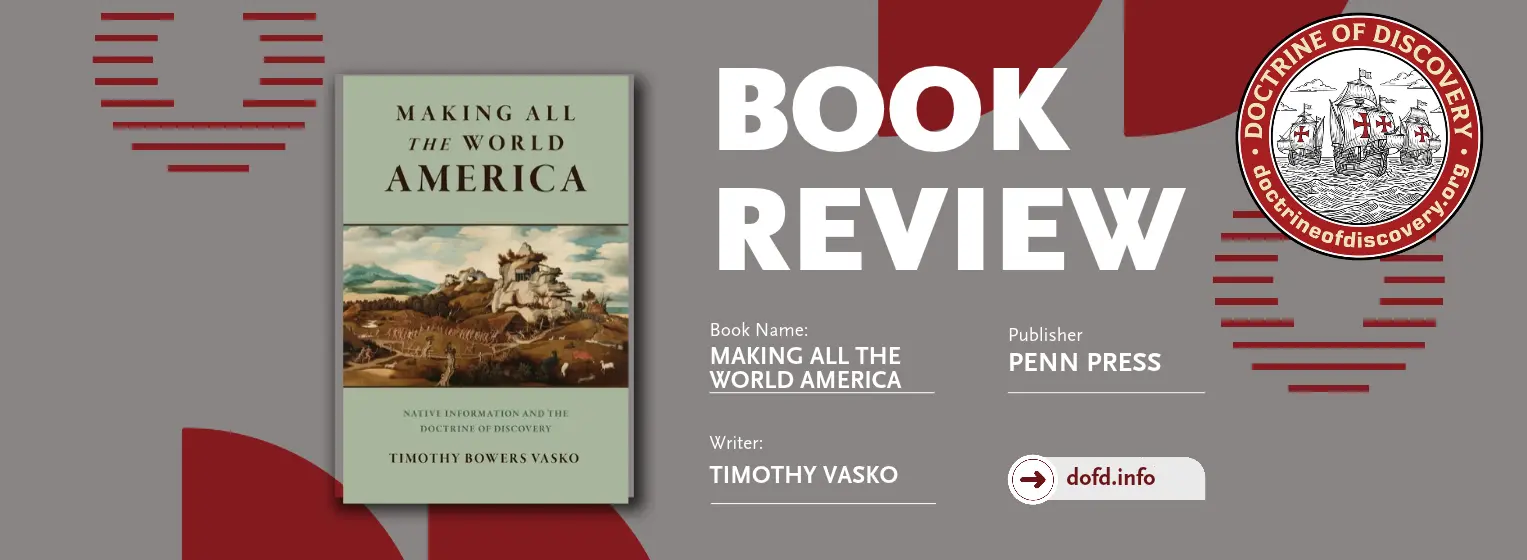

Book Review of Making All the World America
Book Review
Editor’s note: See also Peter d’Errico’s A Comment on Making All the World America, published September 30, 2026, which accompanies this review.
Timothy Bowers Vasko, Making All the World America: Native Information and the Doctrine of Discovery, (University of Pennsylvania Press, April 2026), Pp. 320. Hardcover ISBN 9781512829297, $65.00.
Timothy Bowers Vasko says his book Making All the World America is “a new account of the ideological framework undergirding early modern imperial expansion.” The framework he’s referring to is “the Doctrine of Discovery,” which, he says, “held that the first arrival of a European power among the lands and peoples of the Western Hemisphere granted the right to govern the regions that they claimed to have ‘discovered’.” (p. 2) (Emphasis added) Then, on page 5, Vasko states: “The principle that first arrival to a place granted dominium was fairly straightforward, even if the question of which empire had really arrived in a particular region first remained a point of endless controversy.” (original emphasis)
The above two excerpts from the book illustrate the absence of an etymology of key terms in his book, which, in my view, is indispensable for anyone wanting to engage in this form of scholarship with precision. He does not inform the reader, for example, that the Latin term “dominium” accurately translates into English as “domination.” William Brandon, in his book New Worlds for Old (1989) provides this insight after examining the etymology of dominium, “political power grown from property—dominium— was, in effect domination.”
This leads to a question: How could the arrival of a European power to lands previously unknown to Western Christendom, have supposedly resulted in what Vasko calls a “grant” to that political system of a “right” to establish domination (“dominium”) over those lands? The truth of the matter is that Christian European monarchs purported to grant themselves such a right by fabricating this idea within their own mental world, by means of their language and imagination. Centuries later, in the 1823 ruling Johnson v. McIntosh, on behalf of a unanimous U.S. Supreme Court, Chief Justice John Marshall called this creative use of the imagination an “extravagant” “pretension” “of converting the discovery of an inhabited country into conquest [domination],” which he also termed “ultimate dominion.”
It is clear that Vasko is not oblivious to the theme of domination (he has included the word in his book twenty-one times, and “dominance” four times). For example, on page seven he states that “By the end of the nineteenth century, Marshall’s decision in Johnson v. McIntosh had been adopted by governments in Australia, New Zealand, and Canada, as those colonies and emergent ‘settler’ nations sought to solidify the terms of their ownership of Indigenous lands and domination of Indigenous peoples.” But sadly, his book does not focus on the claim of a right of domination by states over Indigenous nations and peoples, and makes no recommended proposal for some solution to that claim by states.
Vasko’s awareness of the phenomenon of domination in the overall record makes it even more the more disappointing that he has written his book from the perspective of the Western European mental world and system of imagination. He demonstrates this by uncritically calling the claim of a right of “dominium" [domination] based on a claim of “discovery,” “fairly straightforward,” as mentioned above. What’s missing in that framing and throughout the book is any challenge to that ongoing thought process. Vasko is not unique in this regard, however, since a View-from-the-Ship form of scholarship seems to be the default approach to writing about what I prefer to call “doctrine of Christian discovery and domination.”
The ideas and arguments that make up the form of reasoning called “the doctrine of discovery” were the result of a number of Western European monarchies—along with the Holy See of the Catholic Church—forming a specific agreement amongst themselves, as far back as the fourteenth century with regard to Canary Islands, a century and a half before sending voyagers across the Atlantic ocean. Eventually they agreed that once Christian European voyagers successfully identified the location of lands previously unknown to the Christian world, the monarch who sponsored that particular voyage would then be recognized by Western Christendom as having a “right” to establish a system of domination over the geographical area that his or her representatives had identified by sailing across the ocean.
Vasko’s book does not focus on the difference between the View-From-the-Shore perspective of original nations and peoples and a View-From-the-Ship perspective. He also never explicitly highlights the contrast between the free and independent existence of the original nations and peoples and the system of domination carried by ship across the ocean and imposed on everyone and everything. It is that claim of a right of domination which forms the foundation of “U.S. federal Indian law,” which legal scholar Peter D’Errico calls *Federal Anti Indian Law: The Legal Entrapment of Indigenous Peoples (*Praeger Publishing, 2022).
From the Christian Europeans’ View-From-the-Ship perspective, before the voyagers ever set sail it was already assumed by those in power, that if and when the voyagers eventually made landfall, they had “the right” to begin establishing, on behalf of their sponsoring monarch, a system of domination where it did not yet exist. Upon the successful sighting of land on a given voyage, the voyagers began acting upon their presumed “right” by walking ashore and completing certain ceremonial acts. The 1938 book Creation of Rights of Sovereignty Through Symbolic Acts lays this out quite clearly.
Vasko correctly says that most scholars of the doctrine of discovery have “maintained that the doctrine operated through the suppression [domination] of Indigenous peoples.” However, in an apparent effort to demonstrate that his own scholarship is unique, he claims to have arrived at a different interpretation. He asserts that, “to the contrary,” “the doctrine’s ideological work actually depended on the [Christian European] recognition of Indigenous rights and sovereignty.” This strikes me as inaccurate and incomplete.
The effort by the states of Christendom’s, and the effort of successor states, to destroy the free way of life of the original nations and peoples of a newly identified geographical area, makes highly problematic the claim that the Christian Europeans recognized Indigenous “sovereignty.” This framing also places the central focus on the Christian European concept of “sovereignty” rather than on whether the original nations and peoples had the right to continue living a free and independent existence, meaning free and independent of Christian European domination.
Anthony Anghie, in his 2005 book Imperialism, Sovereignty, and the Making of International Law, which Vasko cites, explains that theologian Francisco de Vitoria ultimately refused to acknowledge the Indians as having “sovereignty,” or of being “sovereign,” because they were labeled “pagans,” and because such a recognition would give the non-Christian Native nations and peoples an advantage in their own home territory as against the Spanish crown’s claim of a right of dominium over their homeland.
A fundamental contradiction in Vasko’s own description of his work is revealed by the use of my “domination translator” (i.e. placing the word ‘[domination]’ in brackets after a term of domination). Vasko’s supposedly “new” insight is that during a period of one hundred and ninety-eight years (1492-1690), “the Spanish and English architects of the doctrine [of discovery] sought to justify European-Christian empire [domination] through the incorporation of [free and independent] Indigenous peoples into colonial frameworks as religious, political” and “property owning subjects.” How is this “contrary” to the “suppression” of Indigenous peoples, as Vasko asserts?
The violent process of working to destroy the free and independent existence of original nations and peoples was part of the process of “incorporating” them, by means of domination, “into” the”colonial frameworks” of the empires of Christendom. Manuel Serrano y Sanz’s 1918 book Orígenes de la Dominación Española en America (Origins of Spanish Domination in America) does a good job of explaining this process with regard to Spain (e.g. “Force is neither truth nor justice, but it is indispensable to the propagation of civilization.”)
What Vasko terms “incorporation” was accomplished by what the Spanish crown called the “pacification” (i.e. “suppression”) of the original nations and peoples of a geographical area. Spain called its colonial “missions” “reducciones” (i.e. “reductions”). This reduction process which was deemed subject to Spanish crown law, did not involve recognizing that the original nations and peoples had the “right” to continue living free from Spanish domination. To the extent that the Native peoples were recognized as having “rights,” they were “rights” under and subject to the domination of what Pope Alexander VI called the “Christian empire” (“imperii Christiani”). The papal bull Sublimis Deus of 1537, despite its positive wording did not change this.
Despite Professor Vasko’s obvious awareness of the theme of domination, he never seems to arrive at a key point: Terms and phrases such as “suppression,” “empire,” “dominion," “dominium,” “sovereignty,” “right to rule,” and “right to govern,” all circle back to the central theme of domination and the Christian European claim of a right of domination over non-Christian nations and peoples.
This is why I now call “the doctrine of discovery,” “the doctrine of domination.” The claim of “discovery” is not the issue. The continuing claim of a right of domination over Indigenous nations and peoples (in the name of U.S. “plenary power”), and over their lands and waters (e.g. from the mouth of a river all the way to its source, including all its tributaries) is the central issue we need to address in my view.
Vasko discusses the legacy of the Vatican papal bulls at the opening of his book, where he states:
The Doctrine first appeared between 1452 and 1455, in the papal bulls Dum Diversas and Romanus Pontifex, respectively. In these documents Pope Nicholas V granted the Portuguese crown dominion [domination] over North and West Africa. Four decades later, Pope Alexander VI extended his predecessor’s argument to the recent “discoveries” Christopher Columbus had made under the banner of the Spanish Crown, in the papal bull Inter Caetera in 1493. [p.5]
He fails to note that there are two 1493 papal bulls titled Inter Caetera (dated May 3rd and 4th respectively). He also does not quote the damning language of domination found in the papal bulls of 1452 and 1455: “invade, capture, vanquish, and subdue,” “all Saracens, pagans, and other enemies of Christ,” “reduce them to perpetual slavery,” and “take away all their possessions and property.”
Instead of focusing the readers’ attention on the Vatican’s language of domination, Vasko directs our attention to the theme of evangelism. He evidently wants the reader to know that the Catholic Church saw the Indians as having “souls,” which were in need of being “saved” by the Church, and this became a rationale for Christendom’s imperial expansion. Vasko never acknowledges Pope Alexander VI’s expression of a dark desire on the part of “the Divine Majesty” (“God”), to destroy the free way of life of the original nations (“barbarae naciones”) by “subjugating” them (“deprimantur”) by means of “the Catholic faith,” so as to bring them under the “sway” [domination] of the Spanish monarchs, “en perpetua” (eternally or forever).
Vasko also ignores a sentence from the Vatican papal bull Inter Caetera of May 4, 1493, which states: “We have confidence in Him from whom empires and dominations and all good things proceed.” (The Latin text reads: “In Illo a quo imperial et dominationes ac bona cuncta precedent confidentes,”) The Catholic deity is thereby identified by the Holy See as the divine source of “empires” and “dominations” and "all good things” — the “good things” that can be obtained and achieved by means of the power of empire and domination.
Another sentence in that May 3rd papal bull refers to lands “discovered and to be discovered that are not under the actual temporal domination of any Christian dominators” (which is typically translated as “Christian lords”)—“que sub actuali dominio temporali aliquorum dominorum christianorum constitute non essent”, wording that is repeated again in lines four through six of the papal bull “Dudum Siquidum” dated September 26, 1493.
Vasko writes about “the Doctrine of Discovery” and “the native information at the core of its logic.” (p. 234) This takes us full circle back to his aforementioned definition of the doctrine of discovery quoted on page 5: “The principle that first arrival to a place granted [the first discoverer] dominium.” What kind of “native information” are we being expected to understand is to be found at “the core of its logic” of “discovery” and domination? Are we to believe that the “information” gathered as a result of the intellectual efforts of Indigenous figures such as Garcilaso de la Vega and Don Fernando de Alva Ixtlilxochitl and William Apess somehow ended up at the “core” of the “logic” of Christendom’s system of domination?
Rather than calling for an end to the claim of a right of domination over original (i.e. “Indigenous”) nations and peoples, Vasko suggests that our best course of action is to "confront the Doctrine’s reliance on native information as a legitimating discourse of ongoing imperial authority [domination] and colonial occupation [domination].” Vasko could have suggested that we advocate in favor of original nations and peoples being liberated from the claim of a right of domination by states, but he has suggested a muddled focus: We need to oppose the use of native information to legitimize “ongoing imperial authority and colonial occupation.”
Lastly, toward the end of his book Vasko claims that in March of 2023 the Vatican repudiated “the papal bulls Dum Diversas (1452), Romanus Pontifex (1455), and Inter Caetera (1493).” This a rather surprisingly inaccurate assertion on Vasko’s part. The two departments of the Vatican that issued a joint statement on the doctrine of discovery on March 30, 2023 said nothing about “repudiating” those specific Vatican documents from the fifteenth century. The joint statement of the Holy See only said they “repudiate” “those concepts” that fail to recognize the inherent human rights of indigenous peoples, including what has become known as the legal and political “doctrine of discovery”.”
The Holy See did mention those of us Indigenous scholars who have been working for decades to publicize the issue of the Vatican papal bulls of domination. “Certain scholars,” said the Holy See, “have argued that the basis of the aforementioned ‘doctrine’ [domination] is to be found in several papal documents, such as the Bulls Dum Diversas (1452), Romanus Pontifex (1455) and Inter Caetera (1493).” It is unfortunate, to say the least, that Vasko has published inaccurate information about where things stand with regard to the Vatican’s statement about the doctrine of discovery and the papal bulls of the fifteenth century.
In the concluding paragraph of A Poetic for Sociology (1977), Richard Harvey Brown says that his book is an effort to create a different “form of discourse,” and to arrive at “a method of self-consciousness for sociologists, and for peoples, in their struggle for emancipation.” What Indigenous peoples are attempting to free themselves from, in my view, can be succinctly stated as the claim of a right of domination that continues to be used against them. While this, in my view, is the deeper significance of our effort to investigate “the doctrine of discovery,” it is a point that seems to be lost on most scholars of the field, including Professor Vasko.1
Steven T. Newcomb
Indigenous Law Institute
See also: Peter d’Errico, A Comment on Making All the World America.
CitationPermalink
Newcomb, Steven T. “Review of Timothy Bowers Vasko, Making All the World America: Native Information and the Doctrine of Discovery (university of Pennsylvania Press, 2026)”. The Doctrine of Discovery Project. Syracuse, NY: Indigenous Values Initiative, September 26, 2026. https://doi.org/10.17613/a7tgr-5wq48.
Editor’s note: Vasko’s publication could have benefited from engaging the critical studies of the Doctrine of Christian Discovery published in the last few years, including those produced through our recent focus on “200 Years of Johnson v. M’Intosh (JvM): Indigenous Responses to the Religious Foundations of Racism.” See the project’s outcome documents: Indigenous Values Initiative and Syracuse University, “200 Years of Johnson v. M’Intosh (JvM): Indigenous Responses to the Religious Foundations of Racism,” accessed September 26, 2026, https://outcome.doctrineofdiscovery.org.↩
SUGGESTED CITATION
Steven T. Newcomb, "Book Review of Making All the World America," Doctrine of Discovery Project (26 September 2026), https://doctrineofdiscovery.org/review/9781512829297/.
Download citation formats:
Share on
X Facebook LinkedIn BlueskyDonate today!
Open Access educational resources cost money to produce. Please join the growing number of people supporting The Doctrine of Discovery so we can sustain this work. Please give today.