Papal Bulls
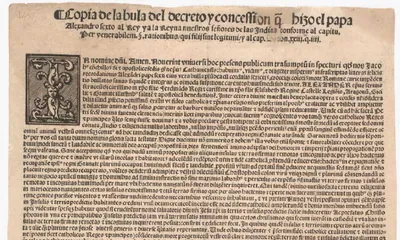
Papal Bulls created the foundation for the Doctrine of Discovery.



Repudiations
Repuidations of the Doctrine of Discovery by religious organizations and faith communities
Papal Bulls created the foundation for the Doctrine of Discovery.
Repuidations of the Doctrine of Discovery by religious organizations and faith communities
Steven T. Newcomb recalls meeting Oglala Lakota educator Birgil Kills Straight in March 1992, and how the two began their call for the Pope to revoke the papal bull Inter Caetera of May 4, 1493.
Robert J. Miller examines how disputes over Indigenous lands and the Doctrine of Discovery shaped grievances in the Declaration of Independence.
Robert J. Miller examines the Doctrine of Discovery’s continuing effects and outlines five strategies for dismantling its influence on Indigenous rights.
Steven T. Newcomb examines the contradictions in the Native American Rights Fund’s amicus brief opposing construction of a U.S.-Mexico border wall on the Tohono O’odham Reservation.
Steven T. Newcomb traces Chief Justice Marshall’s “right of discovery” in Johnson v. McIntosh back to the 1496 Letters Patent to John Cabot and its command to subjugate, occupy, and possess.
Peter d’Errico comments on Timothy Bowers Vasko’s Making All the World America: Native Information and the Doctrine of Discovery (University of Pennsylvania Press, 2026), in conversation with Steven T. Newcomb’s review.
Steven T. Newcomb reviews Timothy Bowers Vasko’s Making All the World America: Native Information and the Doctrine of Discovery (University of Pennsylvania Press, 2026).
Steven Newcomb and Peter d’Errico ask why domination must be treated as the beginning of serious inquiry, not the end of the conversation.
Tom Porter discusses how colonization and the Revolutionary War reshaped Mohawk and Haudenosaunee leadership, identity, and survival.
Haudenosaunee teachings connect ceremony, matrilineal leadership, the Thanksgiving Address, and a living relationship with Mother Earth.
Steve Newcomb and Peter d’Errico unpack tribal sovereignty, limited sovereignty, federal anti-Indian law, and the language trap of domination.
Jordan Loewen-Colon traces how colonial property law survives in AI systems, data extraction, platform consent, and Indigenous data sovereignty.
JCRT publishes the second of two special issues from the 2023 Mapping the Doctrine of Discovery Conference, with scholarship on history, law, and justice.
Newcomb and d’Errico examine the federal Indian law trust doctrine as a euphemism for domination rather than a protective obligation.
Part 2: Indigenous Resistance and the Undoing of Christian Empire This entry connects Doctrine of Discovery scholarship, Indigenous sovereignty, law…